In today's digital age, customers are bombarded with thousands of advertising messages every day. From the moment they wake up and browse Facebook, check their email, to watching a video on YouTube, they are constantly bombarded with offers.
In such a turbulent environment, reaching the right people, at the right time, and with the right message is not just an art, but a key to a business's survival.
That's why Marketing Automation It emerged and quickly became a core "weapon" for business strategists. However, a very common misconception in Vietnam is: "Automation is only an expensive playground for big corporations with billion-dong budgets.".
Is this still true in 2026? For small and medium-sized enterprises (SMEs) with limited resources, is marketing automation a waste of resources or the only leverage to compete on equal footing? Let's dissect this in detail in this article.

What is Marketing Automation Really? It's More Than Just Software
Many people mistakenly believe that Marketing Automation is simply about buying software to send mass emails or a tool to automatically comment on Facebook. This is a very narrow understanding and easily leads to mistakes during implementation.
In fact, Marketing automation is a combination of business strategy and technology platforms. The goal is to automate repetitive marketing processes across multiple channels. Instead of having a team manually sending welcome emails, posting to each social media platform, or using Excel to categorize customers by hand, the 100% system will do all of that for you smoothly and accurately based on pre-established workflows.
The core goal of Marketing Automation goes beyond simply saving time or reducing staff. Its ultimate goal is... Lead Nurturing. By providing highly personalized content based on users' actual behavior, the system will gradually "warm up" the relationship, turning a stranger into a customer, and ultimately into a loyal brand ambassador.
4 "Killer" Features of a Standard Marketing Automation System
To fully understand the power of this technology, we need to delve into the core features that an automation platform (such as the modules in EZ CRM) offers.
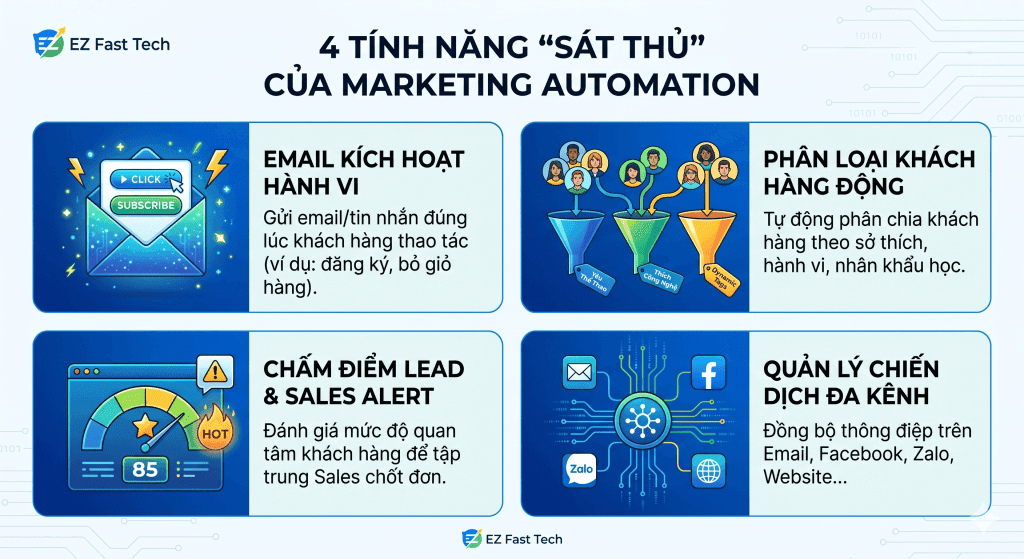
Trigger-based email and message marketing.
Traditional manual email/message campaigns (such as sending the same message to 10,000 people at once) are dying out due to extremely low open rates. Marketing automation completely changes the rules of the game. The system will only trigger the message when the customer performs a specific action. For example: A customer adds a product to their shopping cart but hasn't paid yet. Exactly two hours later, the system automatically sends a reminder email with a discount code 5%. If the customer has just registered as a member, a series of three emails introducing the brand will be sent sporadically over the next week.
Dynamic customer segmentation
No two customers are exactly alike. The automation system allows you to automatically tag and segment customers based on demographics or interaction history. Frequent sports equipment buyers will automatically be categorized as "VIP – Sports Enthusiasts." Those who haven't checked their email in a while will be moved to the "Need to Re-engage" category. This data is constantly changing and automatically updated in real time.
Lead Scoring
This feature completely revolutionizes the workflow of the Sales department. Instead of blindly calling 100 phone numbers with unclear needs, the system scores each customer. For example: Customer opens email (+5 points), customer clicks on a price quote link (+10 points), customer views product page for more than 3 minutes (+15 points). When a customer reaches 50 points, the system automatically alerts the Sales staff to call and close the deal immediately because this is when the customer is most "hot.".
Omnichannel Orchestration
Customers aren't just on one channel. They browse Facebook, search Google, read emails, and chat on Zalo. Marketing automation integrates this experience. If they've already made a purchase on the website, the system automatically removes them from the "Find New Customers" ad file on Facebook to avoid wasting money, and redirects them to the "Return Customers" funnel on Zalo ZNS.
Why Do Small Businesses Need Marketing Automation More Than Large Corporations?
Many small and medium-sized business owners often have this hesitant mindset: "My company is small, with only a few dozen customers a day. My staff can handle everything manually, so why buy software and waste money?".
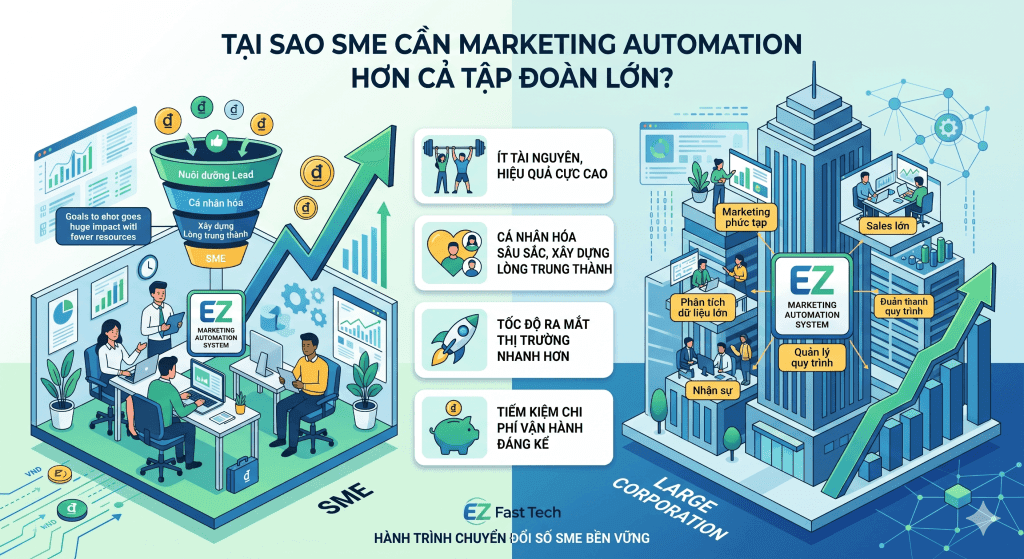
The reality proves the exact opposite. Large corporations can afford to hire hundreds of call center staff and run extensive advertising campaigns. SMEs don't have that privilege. Here are four reasons why Marketing Authorization (MAC) becomes a lifeline for small businesses.
A small but highly productive workforce.
Small businesses often face the challenge of limited payroll budgets. Without a large marketing department, a single employee often has to handle everything from writing and posting content to running ads and managing the fan page. Overload inevitably leads to mistakes. This is where Marketing Automation comes in handy, acting as a "virtual super-employee" working 24/7/365, never asking for a raise, never taking sick leave, and never forgetting tasks. It helps your business operate with the capacity of 5-10 people with just a few clicks of initial setup.
Delivering a personalized experience to compete with the "big players".“
Today's customers are extremely averse to generic, "spam-like" content. They want to feel understood. Imagine receiving an email like, "Hi Nam, we know you're a huge Sony camera fan, and here's the latest lens that's perfect for your A7 Mark III that you bought last month"? This deep personalization creates a "wow moment." It allows a small camera shop to build customer loyalty far better than even the most soulless, giant electronics supermarkets. And this is only possible thanks to an automated data analytics system.
Never miss the "Golden Opportunity" to close a sale.
In today's fast-paced digital age, customer patience is measured in seconds. If a customer leaves their contact information at 11 PM, and you wait until 9 AM the next day to respond, chances are they've already purchased from a competitor. With MA, as soon as the information is saved to the system, an automated message or email will be sent: "Thank you for your interest, our specialist will contact you tomorrow morning. In the meantime, you can preview the price list here…". You can retain customers even while they sleep.
Optimizing the advertising cost funnel (CAC vs LTV)
The cost of acquiring a new customer (CAC – Customer Acquisition Cost) is becoming increasingly expensive due to the continuous rise in advertising bids on Facebook and Google. Statistics show that the cost of acquiring a new customer is 5 to 7 times higher than the cost of retaining an existing one. Instead of continuously pouring money into the input funnel, Marketing Automation focuses on leveraging the lifetime value (LTV – Customer Lifetime Value). The system automatically reminds you of maintenance appointments, sends birthday offers, and automatically invites you to upgrade your products (Upsell). You increase your profit margin without spending any additional advertising costs.
A 4-Step Roadmap for Implementing Marketing Automation for SMEs to Avoid the Risk of Failure
Knowing is good, but how do you get started without wasting money? Here's advice from our systems architecture experts to help SMEs take the most solid steps.
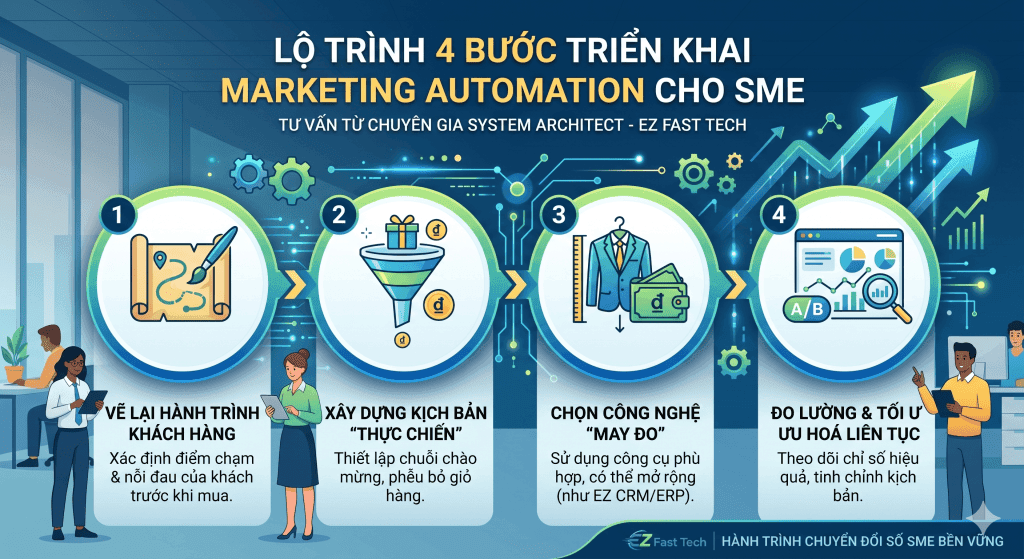
Step 1: Stop buying software and start by redrawing the “Customer Journey”.”
Don't rush into buying expensive platforms when you're not sure what you want to automate. The golden rule is: Never automate a process that's already broken. Sit down with your team and use pen and paper to map out every customer touchpoint from the moment they learn about you, consider buying, complete payment, to return for a second purchase.
Step 2: Start with "Real-world" scenarios that generate immediate revenue.
Don't build complicated, intricate scenarios right from the start. Begin with the three most basic scenarios that have the potential to generate immediate revenue:
- Abandoned Cart Scenario: Remind those who intended to buy but haven't paid yet.
- Welcome Series Script: A series of 3-5 emails will build brand credibility once someone signs up for the newsletter.
- Post-purchase review request script: Automatically send a message requesting feedback and offering a discount code for their next purchase exactly 3 days after the customer receives their order.
Step 3: Choose the "Tailored" technology that fits your budget.
Small businesses don't necessarily need to splurge on Salesforce or Adobe Marketplace, costing thousands of dollars a month. There are many good starting platforms like Mailchimp and GetResponse. Especially if you want a tightly integrated system for Marketing, Sales, and Accounting, comprehensive management solutions like... EZ ERP/CRM A product specifically designed for the Vietnamese market would be the optimal choice, ensuring uninterrupted data flow between departments.
Step 4: Measurement, A/B Testing, and Continuous Refinement
Automation doesn't mean "Set it up and forget it." You need to continuously monitor key metrics like Open Rate, Click-through Rate, and Conversion Rate. Performing A/B testing (testing two different email subject lines to see which is more effective) is a weekly task to optimize this money-making machine.
Conclusion: Digital Transformation or Being Left Behind?
Marketing automation is not a fleeting trend, nor is it the exclusive privilege of wealthy giants. For small and medium-sized enterprises (SMEs), it is a survival tool, a leverage to optimize limited resources and compete with a superior customer experience.
Many people fear that automation will strip away the "human" aspect of business. But the truth is: Automating repetitive, machine-like tasks is the best way to free up human resources. When your team no longer has to painstakingly copy and paste data, they'll have more time to create brilliant strategies and engage in genuine, human conversations with customers who need empathy the most.
Investing in marketing automation today is not a technology expense, but an investment in your business's core competitive advantage for the next decade.
Contact us today to let EZ Fast Tech help your business Transform yourself to become more professional in the era of digital transformation!
- Website: https://ezfasttech.com
- Hotline: 0768945786
- E-mail: [email protected]
- Facebook: https://www.facebook.com/ezfasttech