In today's fast-paced tech world, sometimes the biggest difference comes from the small, understated details. We meticulously care for a traditional store, from the lighting and scent to the way employees smile and greet customers. So, in the digital space, how can we make customers feel that warmth and dedication?
The answer lies in the website's ability to "understand" customer behavior – where technology is used to connect people's minds, rather than just dry lines of code.

Websites that understand customer behavior – When technology starts to care
For a long time, many businesses have made a common mistake: treating website visitors as mere soulless statistics on Google Analytics (such as bounce rate, time on page, number of clicks). But behind each IP address is a real person, with problems, emotions, and desires that need to be addressed.
Instead of treating them as "traffic," welcome them as valued guests visiting your home. A website that listens won't display everything loudly and aggressively, forcing customers to buy immediately with flashing pop-ups. Instead, it will gently observe, analyze, and respond:
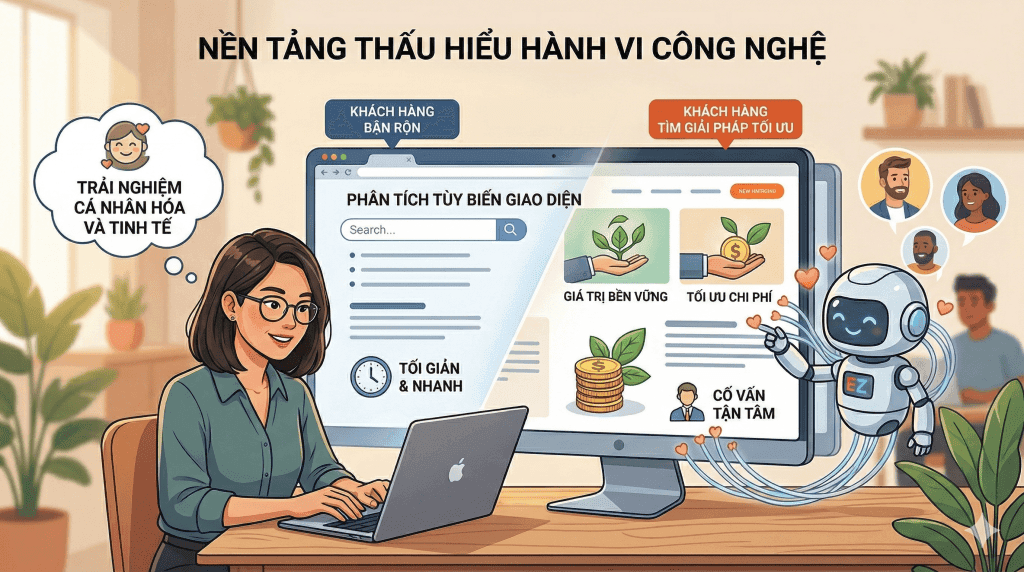
- For customers looking for cost-saving solutions: A well-informed website won't rush to showcase the most expensive service packages. Instead, it will subtly navigate, prioritizing content that shares sustainable value, cost-saving guides, or basic yet highly effective service packages.
- For busy users or senior management: The interface needs to automatically remove unnecessary decorative elements. It becomes minimalist, focusing on a smart search bar, clear navigation menus, and providing executive summaries so users can find what they need in seconds.
- For guests who are in the research phase: The website will act as a mentor. Instead of a "Buy Now" button, it will suggest in-depth blog posts, e-books, or tutorial videos to gradually nurture knowledge and build confidence.
This change doesn't need to be flashy. Sometimes, customers don't even realize the website is changing because of them. They simply feel "comfortable" because their personal space and individual needs are respected. That's the pinnacle of user experience (UX) design.
Build trust through small details.
Deep personalization is no longer a technical term exclusive to giant tech corporations. It has become the new standard, the embodiment of hospitality in the online environment.
Today's customers are extremely averse to generic advertising messages, like receiving a typed letter sent to thousands of people without their name on it. A website that understands this will become more sophisticated by remembering and adapting accordingly:
- Subtle suggestions for unfinished topics: If a customer was reading an article about software solutions for SMEs last time, the website will gently suggest that topic again on their next visit, or suggest a similar case study. It's like a waiter remembering a regular customer's favorite drink.
- Suitable for your habits and physical condition: Understanding also lies in including everyone. Websites can automatically recognize user settings to activate Dark Mode to protect eyesight, or provide options to increase font size or change contrast to suit the visual habits of older customers.
- Language and culture: When working with partners in countries with diverse cultures, a professional website will not simply translate word-by-word. It will automatically display date formats, currency, and forms of address that are appropriate to the local culture of the visitor.
These small but carefully calculated gestures send a powerful message: “"We genuinely care about your personal experience, not just about getting your money."”.
The digital space also needs to "breathe".“
In practical architecture, open spaces (skylights, courtyards) are just as important as walls. The same is true in website design. A website that understands this will know how to create a "breathing rhythm" for the user through white space.
Don't try to cram too much text, animation, or auto-playing videos onto a single screen. This causes cognitive overload. Empathetic design arranges information according to the natural visual flow of the human eye, allocating rest periods for the eyes, allowing the customer's mind to relax while receiving your message.
The silence on a website can sometimes be more persuasive than thousands of noisy sales pitches.
Technology goes hand in hand with kindness.
At EZ Fast Tech, We have always believed that technology is only truly valuable when it serves people kindly. Applying artificial intelligence to tailor the interface to user behavior is not a way to control users, but rather to remove barriers and make the customer's information search journey more relaxed. That's how a website "understands" customer behavior.
Every line of code we write is geared towards a single goal: to help your message reach your customers in the most natural and genuine way possible.
A message from the heart
A beautiful website may attract attention, but a website that truly understands customer behavior is what truly resonates with customers. If you're looking to build a digital space that's unique and empathetic, let us share the first steps with you.
In 2026, let's work together to create digital experiences where people are always at the center of all development.
EZ Fast Tech's little corner
We're always happy to sit down with you and listen to your concerns about digitizing your business. It doesn't have to be a big project; sometimes it's just a few small ideas to make your website more accessible to customers. Don't hesitate to connect with us. EZ Fast Tech When you need a dedicated companion.
Are you ready to upgrade your business's digital image? Contact the EZ Fast Tech team today for advice on the best website design and software solutions for 2026.
- Website: https://ezfasttech.com
- Hotline: 0768945786
- E-mail: [email protected]
- Facebook: https://www.facebook.com/ezfasttech
- LinkedIn: https://www.linkedin.com/company/ez-fast-tech/