In the early days of entrepreneurship, Excel spreadsheets were like a versatile "companion" for every business owner. From recording income and expenses, managing customer information, to tracking inventory, an Excel file seemed capable of handling everything at zero cost.
However, as the workforce grows, the volume of data swells, and departments need seamless coordination, Excel begins to reveal its fatal weaknesses. Fragmented data, errors due to manual data entry, and leaks of sensitive information are silently stifling business growth.
It's time for SMEs (Small and Medium-sized Enterprises) to adopt a new management mindset, one that is more automated and synchronized with professional ERP/CRM systems.
What are the basic concepts of ERP and CRM in modern management?
Before delving into why Excel needs replacing, we need to clarify two fundamental concepts in the modern enterprise management software ecosystem:
- ERP (Enterprise Resource Planning): This is a single software system that integrates all core business processes into a common database. Instead of accounting using one software, inventory using another, and human resources using separate files, ERP connects them all. When an order is created, inventory is automatically debited, accounts receivable are automatically recorded, and HR is compensated.
- CRM (Customer Relationship Management): CRM is a system focused on storing, analyzing, and optimizing all interactions with customers. From the moment they are just potential customers (leads), through the stages of consultation, quotation, sales closing, to after-sales service, CRM helps businesses not miss any business opportunities.
In many modern systems, CRM is often integrated as a crucial subsystem within an overall ERP ecosystem.
Why was Excel once "king" but is now outdated?
The greatness of Microsoft Excel is undeniable. It's easy to learn, easy to customize, and almost free if you already have a suite of office tools. For a small shop or a company with fewer than 5 employees, Excel is sufficient.
However, Excel's limitations lie in the very nature of its architecture: It is a personal tool, not a collaboration system.
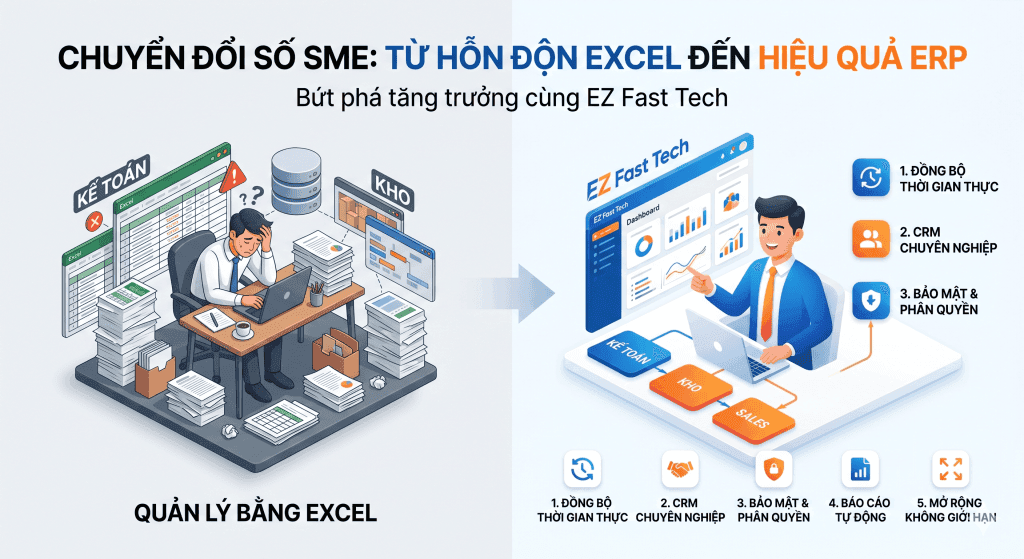
When your business starts to have Marketing, Sales, Accounting, and Operations departments, Excel turns into a "nightmare" called Silos (data oasis). Marketing has a customer list file. Sales copies that file to make calls and take notes. Accounting uses another file for reconciliation. When the CEO needs a summary report at the end of the month, department heads have to spend days piecing together data from dozens of different files, along with the extremely high risk of errors due to incorrect copying/pasting or accidentally deleting formulas.
5 Reasons Why SMEs Should Switch from Excel to ERP/CRM
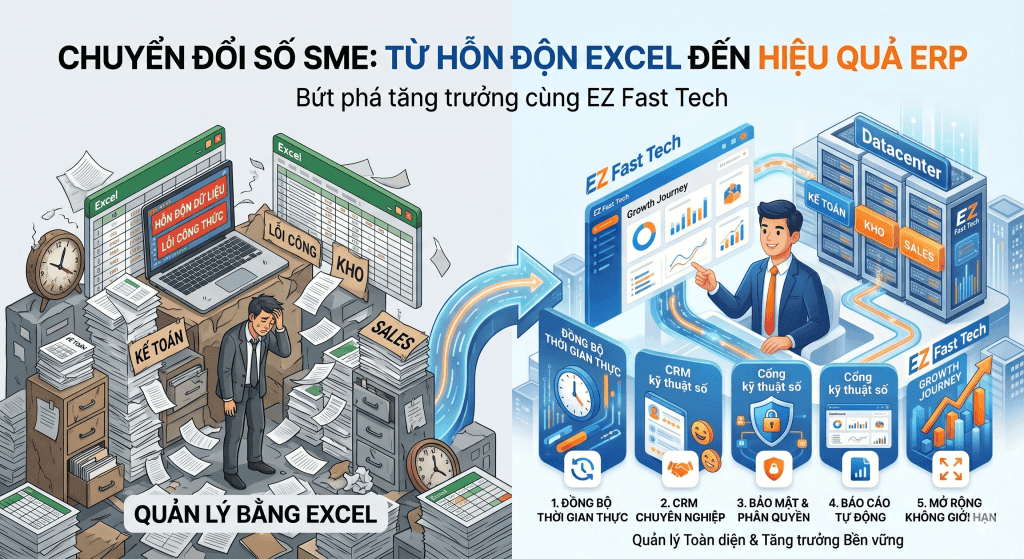
Digital transformation is not just a trend, but a matter of survival. Here are 5 "vital" reasons why SMEs must replace Excel:
1. Real-time data synchronization
With ERP, the concept of "waiting until the end of the day to compile data" will completely disappear. All information flows are updated in real time. When a sales employee closes an order on the system, the warehouse manager immediately receives the shipping order, and the accountant sees the projected cash flow.
This synchronization completely eliminates information inconsistencies between departments, allowing the system to operate smoothly with zero delay.
2. Professional Customer Relationship Management (CRM)
A salesperson quits, taking with them an entire Excel file containing hundreds of important customer contacts. This is a heartbreaking scenario, but it happens daily in SMEs.
With CRM, customer data is the company's asset, not an individual's. The system records the entire history of interactions, from calls and emails to quotes and personal preferences. Even with personnel changes, a new person can take over and smoothly manage customer relationships in just a few minutes by reviewing the CRM history.
3. Detailed security and access control
Even with a password, an Excel file can easily be copied, emailed, or transferred to a USB drive. You have no control over who has viewed or modified the information.
In contrast, ERP/CRM systems allow for extremely detailed access control configurations. Sales staff only see their customers, accountants only see financial data, and only management has the right to export data. Every operation (adding, editing, deleting) is clearly logged by the system, ensuring absolute transparency.
4. Report and analysis automation (Dashboard)
Instead of struggling with complex and easily broken VLOOKUP and Pivot Table functions, the software system provides intuitive and dynamic dashboards. Business owners can track daily revenue, conversion rates for each sales employee, or inventory levels… with just a few clicks, right on their mobile phones, anywhere. Decisions are made quickly based on data, not on intuition.
5. Unlimited scalability
Excel will start to lag and freeze when the number of rows reaches tens of thousands. But a modern cloud-based ERP/CRM system can handle millions of records simultaneously.
As your business expands by adding branches, warehouses, or tripling its workforce, the software system continues to run smoothly, ready to meet the scale of a large corporation.
Analyzing the ROI (Return on Investment) problem for SMEs.
Many business owners are concerned about the higher initial software implementation costs compared to using "free" Excel. However, consider the hidden costs of using Excel:
- Time cost: Let's say your 5 employees spend 1 hour each day manually entering data and cross-checking figures. That's 130 hours of work per month. What is the cost of wasted labor?
- Opportunity cost: Forgetting customer service appointments and sending quotes late because you're struggling with Excel files can cost you 2-3 large contracts each month.
- Risk costs: Errors in inventory files can lead to over-inventorying and tied-up capital, or accounting file errors can result in cash flow losses.
Compared to these enormous losses, investing in an ERP/CRM system yields an extremely high return on investment (ROI). Automation frees up labor, allowing the team to focus on generating revenue.
EZ Fast Tech – A "tailor-made" ERP/CRM solution for Vietnamese businesses.
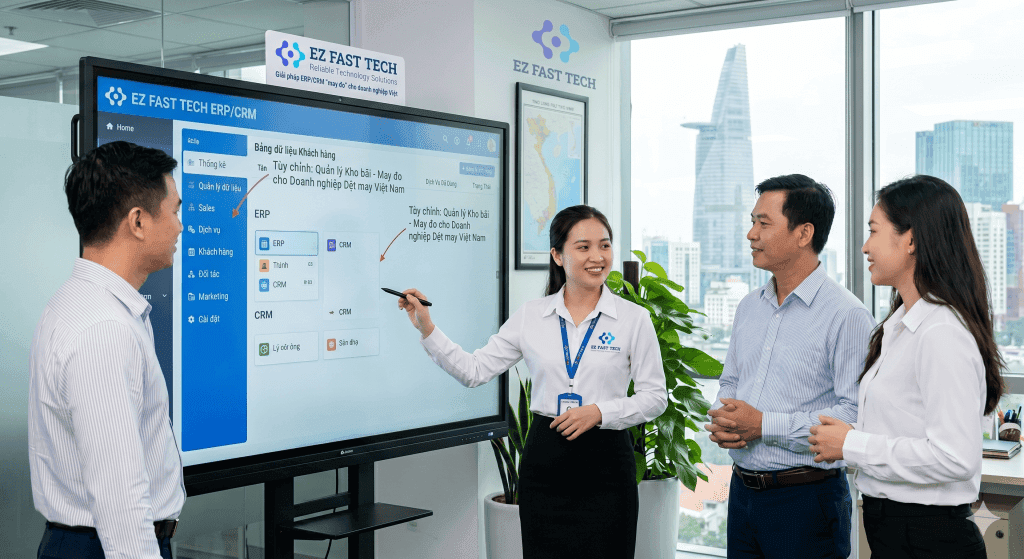
Thị trường hiện nay có rất nhiều nền tảng phần mềm đóng gói sẵn (SaaS). Tuy nhiên, mỗi doanh nghiệp đều có những quy trình, đặc thù kinh doanh hoàn toàn khác biệt. Việc gò ép quy trình của mình vào một phần mềm cứng nhắc thường dẫn đến sự thất bại trong chuyển đổi số. EZ Fast Tech có bài phân tích việc các doanh nghiệp SME nên dùng phần mềm ERP xây mới hay nên tảng đóng gói sẵn here để cân nhắc cho việc lựa chọn gói phù hợp cho đặc điểm của doanh nghiệp mình
Understanding this pain, EZ Fast Tech We offer customized ERP and CRM system development solutions tailored to each client. With a focus on applying international standards and a global mindset to the domestic SME market, our system architectures are designed to ensure high performance, robust operation, and maximum security. Our solid expertise is built upon over 15 years of practical experience in the IT industry, along with direct experience in developing and optimizing management and operational systems for multinational projects.
Furthermore, transparency is a core philosophy. A governance system is an invaluable digital asset for any business. Therefore, EZ Fast Tech is always committed to delivering complete solutions. source code Upon project completion, the client will own their 100% technology, be independent of any vendor throughout its lifecycle, and have the freedom to upgrade and expand in the future.
The roadmap for migrating from Excel to professional software.
Transitioning from an old routine to a new system is never something that can be done overnight. To ensure the highest success rate, SMEs need to follow this roadmap:
- Auditing and Process Standardization (Process First, Tools Later): You can't automate a mess. Before writing any code, you need to redraw the current process, eliminate unnecessary steps, and standardize the data flow.
- Consulting and Solution Development: Conduct a detailed requirements analysis to identify the necessary subsystems (Sales, Inventory, Accounting, Human Resources).
- Planning and Implementation: Establish a clear timeline. A key practical tip when managing technology projects is to always set buffer time during testing phases. This allows the team sufficient time to fine-tune and handle unforeseen issues without disrupting the overall schedule.
- Data Cleaning and Conversion: Gather all data from the old Excel files, clean them (remove duplicates, standardize formatting), and import them into the new system.
- Training and testing in parallel: Training staff on how to use the system is recommended. It is advisable to run both the old (Excel) and new (ERP) systems in parallel for the first 1-2 weeks to allow staff to familiarize themselves with the new system and compare and verify the results.
- Official Operation and Optimization: Completely replace Excel and switch to a new system. Continuously gather feedback from employees to refine the UI/UX and features.
Conclusion: Don't let Excel hold back your growth.
Excel spreadsheets have served their historical purpose well when your business is just starting out. But as you aim to scale, accelerate revenue, and build a professional team, Excel has become too small a tool.
Transitioning to an ERP/CRM system is not simply about buying software; it's a comprehensive upgrade in management thinking. Investing wisely in technology infrastructure, owning the full source code, and mastering the data are the golden keys to helping SMEs thrive in the digital age.
Contact EZ Fast Tech today to receive advice on the optimal solution for your business!
- Website: https://ezfasttech.com
- Hotline: 0768945786
- E-mail: [email protected]
- Facebook: https://www.facebook.com/ezfasttech
Sources for further knowledge enhancement:
- Gartner: What Is ERP? (Enterprise Resource Planning) – In-depth analysis from a world-leading technology research organization on the architecture and core values of ERP.
- Forbes: CRM vs. ERP: What's The Difference? – This report provides a detailed comparison and explains how these two systems complement each other to increase business profitability.
- Harvard Business Review: Why Your Company Needs to Stop Using Excel – This article analyzes the financial and managerial risks when large businesses still rely on manual spreadsheets.
- IBM: What is CRM? – The concept of data-driven approaches in customer journey management.