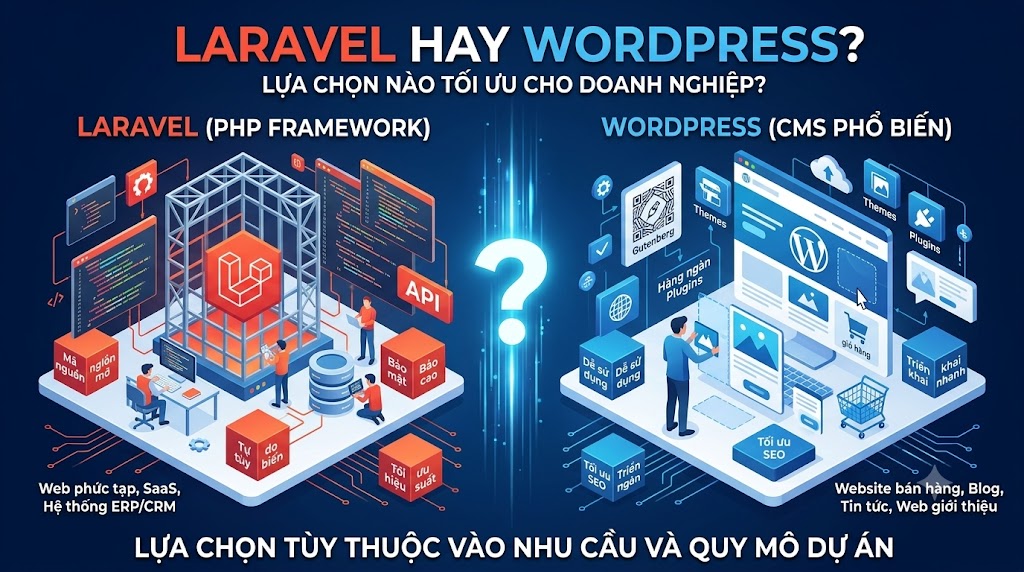
In the era of digital transformation, "application" has become a buzzword for every business owner. However, misunderstanding the nature of different application types can lead to billions of dollars in wasted investments. This article will break down the concept of applications in detail, including Web Apps, Mobile Apps, and PC Apps, and help you choose the right platform to optimize your business processes.
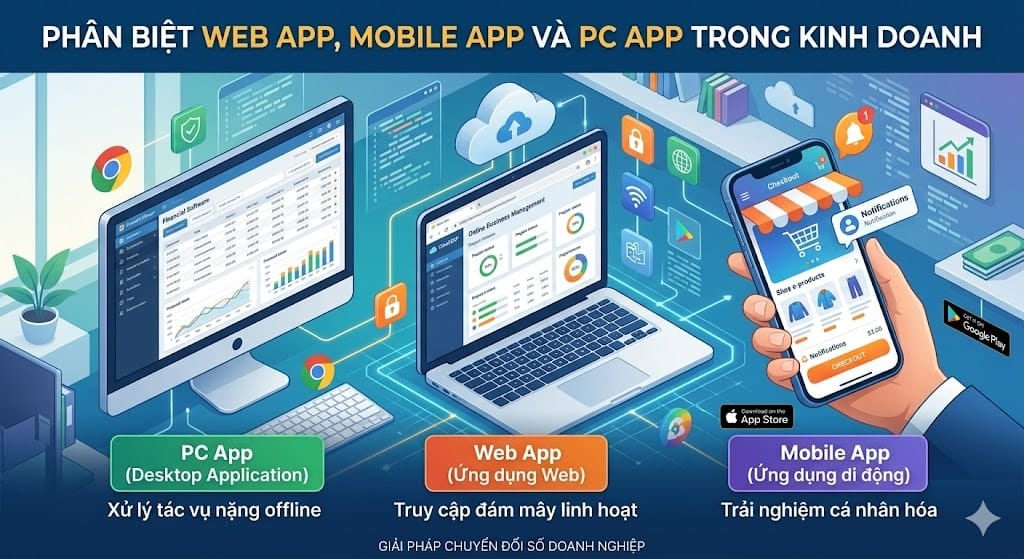
Fundamental concept: What is an application?
Application, An application, or simply an "app," is a type of computer program designed to perform specific functions, tasks, or activities for the end user. Unlike operating systems (Windows, macOS, iOS), which are the platforms on which computers run, applications are tools that run on that platform to solve a real-world problem.
Trong kinh doanh, ứng dụng đóng vai trò là cầu nối tương tác giữa doanh nghiệp và khách hàng, hoặc là bộ máy vận hành nội bộ. Tùy vào môi trường thực thi mà ứng dụng được chia thành 3 nhóm chính: Web App, Mobile App và PC App.
A detailed analysis of the three most common application types.
PC App (Desktop Application) – Traditional Application
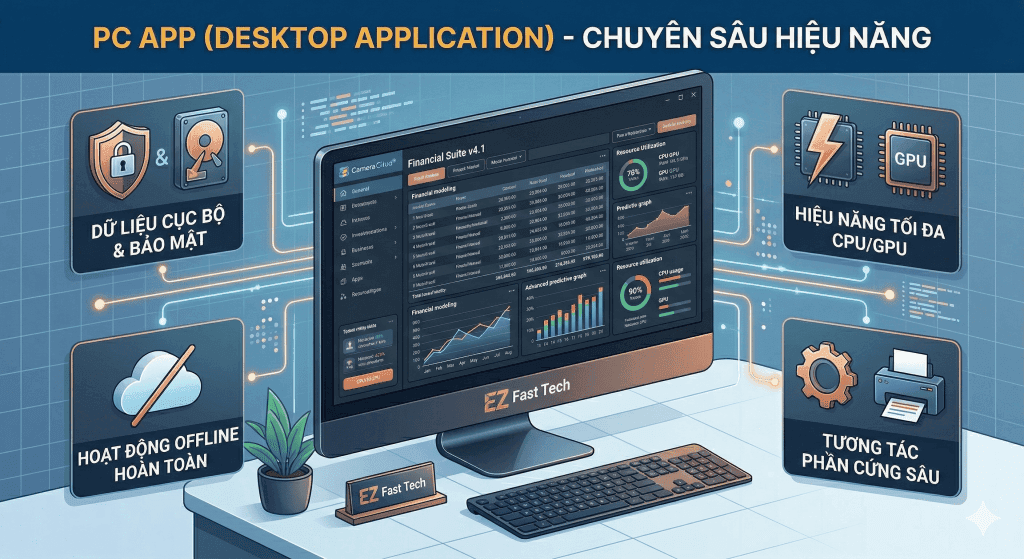
PC apps are software programs installed directly onto a computer's hard drive (desktop or laptop) and run on operating systems such as Windows, macOS, or Linux.
- Characteristic: Maximize the power of your device's hardware (CPU, RAM, GPU). Offers strong offline performance.
- For example: Microsoft Word, Adobe Photoshop, offline accounting software.
- Advantages: Extremely fast processing speed for demanding tasks, high security due to the ability to store data locally.
- Disadvantages: It's difficult to synchronize updates for multiple users, maintenance costs are high, and it's limited by the devices it's installed on.
Web App – An “Office” in the Cloud
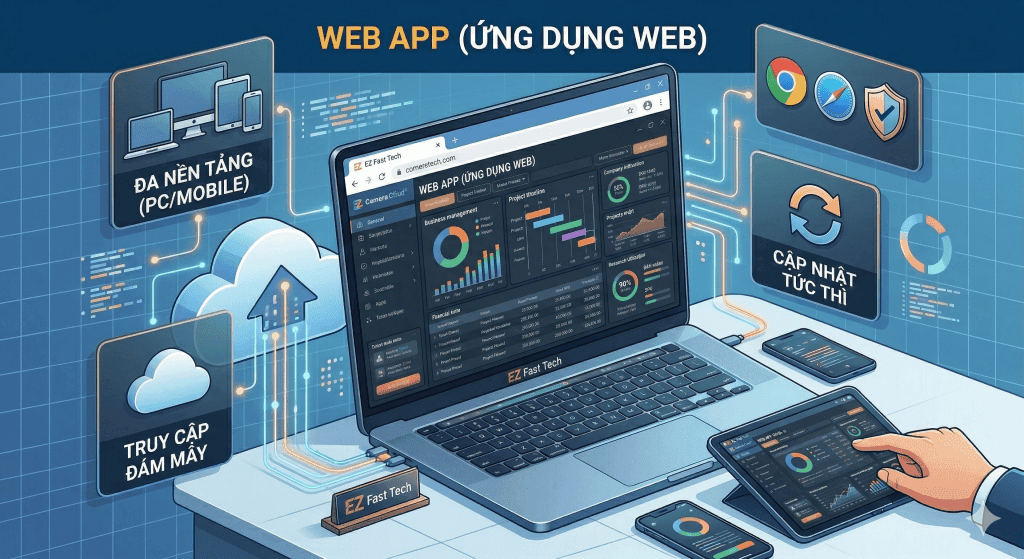
Web apps are applications that run on web browsers (Chrome, Safari, Edge) via the internet. Users do not need to install any files on their computers.
- Characteristic: Using modern technologies like ReactJS, Angular, and VueJS to create a smooth experience that's almost like installed software.
- For example: Google Docs, Facebook, and online ERP/CRM systems.
- Advantages:
- Flexibility: Access anytime, anywhere, as long as you have an internet connection.
- Compatibility: It runs well on PCs, tablets, and phones without requiring extensive code rewriting.
- Instant update: When the developer changes the source code, all users receive the update as soon as the page reloads.
Mobile App – The ultimate personalized experience.
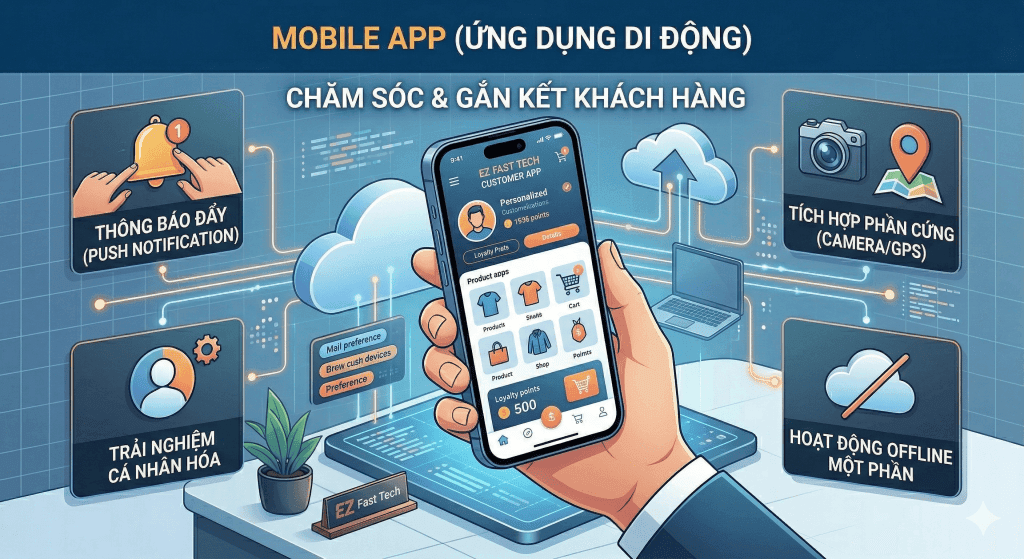
Mobile apps are applications developed specifically for mobile devices (smartphones, tablets), usually downloaded from the App Store (iOS) or Google Play (Android).
- Characteristic: Optimized for touchscreens and deeply integrated with phone features such as camera, GPS, fingerprint sensor, and push notifications.
- For example: Shopee, Grab, Zalo, Banking App.
- Advantages: * Speed: Web apps on mobile are faster because the interface data has already been downloaded to the device beforehand.
- Customer engagement: Push notifications help businesses reach customers 24/7.
- User experience (UX): Smooth, intuitive, and highly personalized.
Comprehensive comparison table: Which is the right choice for your business?
| Criteria | PC App | Web App | Mobile App |
| Setting | Obligatory | No need (Use a browser) | Obligatory |
| Network connection | Can be used offline | Internet access is required. | It can be partially used offline. |
| Speed | Very fast (Based on hardware) | Network speed is dependent. | Fast & smooth |
| Update capability | Slow, manual operation, machine by machine. | Instant for everyone to use. | You need to go through the app store. |
| Development costs | High | Reasonable | High |
| Appropriate purpose | Heavy graphics, large data processing | Internal management, e-commerce, SaaS | Customer care, mobile services |
Why does EZ Fast Tech focus so heavily on Web Apps and Mobile Apps?
At EZ Fast Tech, Instead of spreading ourselves too thin, we focus all our resources on two key areas: Web Application and Mobile App. This decision is based on over 15 years of experience in the industry and actual market trends:
- The rise of Cloud Computing: Web apps help businesses overcome geographical barriers. Managing an ERP or CRM system through a web browser allows executives to monitor business performance even while traveling.
- The Mobile-First Era: Over 80% of internet traffic now comes from mobile devices. Owning a mobile app is no longer a "nice to have" but a "mandatory" step to retain loyal customers.
- Optimizing costs for customers: Instead of investing in PC apps, which are difficult to maintain, web and mobile apps allow for rapid deployment and easy scaling up as the business grows.
- Commitment to transparency: We focus on delivering the 100% source code, ensuring businesses have full control over their digital assets on both Web and Mobile platforms.
Expert advice: A roadmap for building an effective app.
As engineers with extensive practical experience in international markets such as Singapore, the UK, and the UAE, we have developed a four-step roadmap for building successful applications:
Step 1: Identify the core problem
Don't build an app just because "the competition has one." Instead, answer this question: What customer pain point or company process bottleneck does this app solve?
- If inventory and personnel management is required: Prioritize Web App.
- If sales, loyalty point, or delivery are required: Prioritize these. Mobile App.
- Đọc thêm here để hiểu khi nào chọn Web App, khi nào chọn Mobile App
Step 2: UX/UI Design – User Experience is Number One
An application with many features but difficult to use will be removed within the first 30 seconds. The interface needs to be intuitive, page load speed should be under 2 seconds, and the operation process should be as simple as possible.
Step 3: Choose sustainable technology
Don't chase after "short-lived" technologies. Use platforms with large, supportive communities (like React, Flutter, Node.js) for easier maintenance and upgrades in the future.
Step 4: SEO and Marketing Strategy for the App
If it's a web app, focus on SEO-friendly structure, page load speed, and EEAT to get a high ranking from Google. If it's a mobile app, focus on ASO (App Store Optimization) so that the app always ranks highly when customers search for related keywords.
Conclude: Each type of application has its own strengths. However, in the modern context, the combination of Web App (for administration) and Mobile App (for customer interaction) This is the "golden formula" for sustainable growth.
If you're unsure about the technical solution for your project, let the experts at EZ Fast Tech We support you in realizing your ideas with the highest level of transparency and professionalism.
Contact EZ Fast Tech today to receive advice on the optimal solution for your business!
- Website: https://ezfasttech.com
- Hotline: 0768945786
- E-mail: [email protected]
- Facebook: https://www.facebook.com/ezfasttech